
Already have sequencing data? We turn it into answers.
Custom analysis, figures and a Methods section for sequencing data from any provider, core facility or public archive.
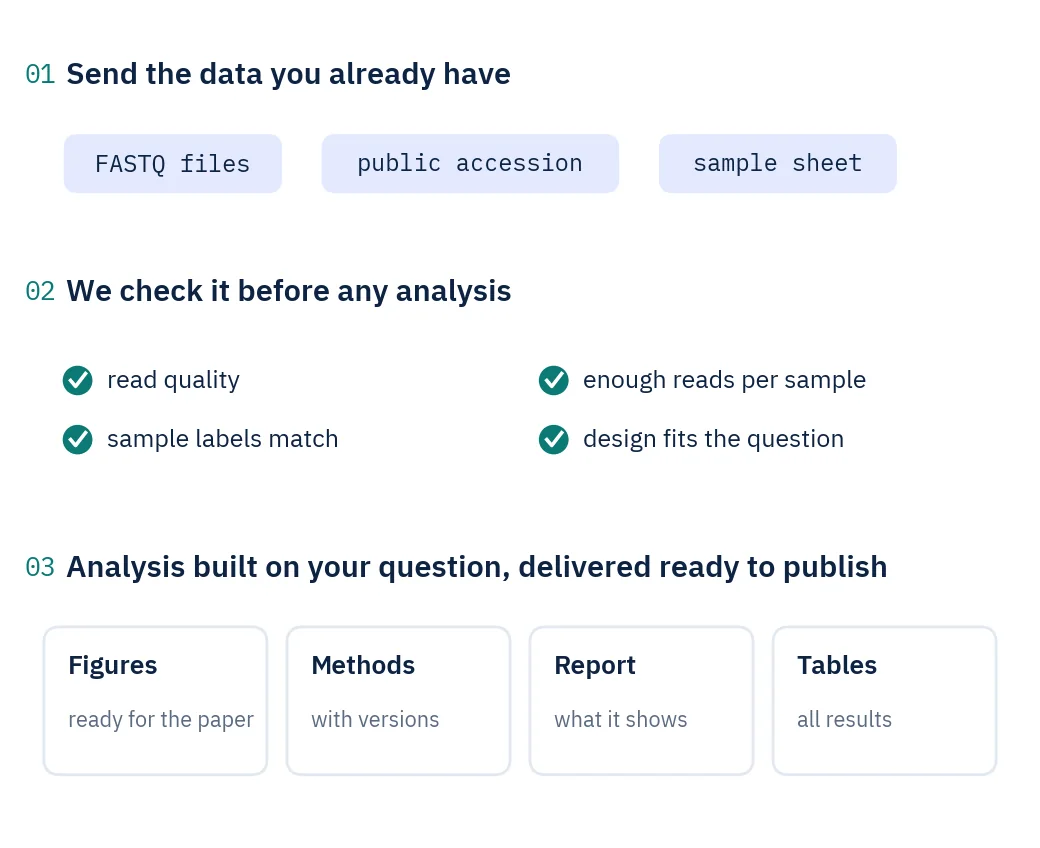
From raw files to a checked report.
A sequencer delivers FASTQ files: millions of short reads, each with a quality score for every letter. Between those files and a figure in a paper lie many steps, and each assay needs its own. RNA-seq, microbiome, methylation and genome data are all analysed differently.
We start by checking the data: read quality, reads per sample, whether the sample labels match the files, and whether the design supports the comparisons you want. The analysis is then planned around your groups, replicates and question.
Analyses run in versioned community pipelines, and the software versions go into the Methods section. Every number in the report comes from one results table, and automated checks compare the text, tables and figures before anything is delivered.
Key terms
- FASTQ
- The standard file of sequencing reads, with a quality score for every letter.
- Quality control
- Checking that reads are usable, and removing adapter sequence and poor-quality bases.
- Reference genome
- The assembled genome of your organism, which reads are compared against.
- Normalisation
- Adjusting counts so that samples sequenced to different depths can be compared fairly.
- False discovery rate
- The expected share of false positives among results called significant.
- Pipeline
- A scripted, versioned chain of analysis steps that runs the same way every time.
Sound familiar? This is the part we take over.
- Has your data been sitting on a drive for months?
- Did your provider send raw files and no interpretation?
- Has a reviewer asked for an analysis you cannot run yourself?
- Do you need figures and a Methods section for the paper?
Where it is used
- Microbiome data16S, ITS, 18S and COI amplicons and shotgun metagenomes.
- RNA-seqDifferential expression and pathway analysis from bulk RNA data.
- DNA methylationWGBS and RRBS data compared between groups.
- Genomes and exomesGermline variant calling and classification, and genome assembly from long reads.
- Population genomicsddRAD data analysed for structure, diversity and relatedness.
- Immune repertoiresT-cell receptor sequencing: clonotypes, diversity and gene usage.
Four steps from your files to results.
- Step 1
Tell us about the data
A short email with the assay, the organism, the groups and the question. We check that the plan fits the data.
- Step 2
Send the files
Raw FASTQ files through an upload link, or the accession number of a public dataset, plus a sample sheet.
- Step 3
Check the data
Read quality, reads per sample and sample labels are checked before the analysis starts.
- Step 4
Analyse and report
Analysis matched to your design, delivered with figures, tables, a report and a Methods section.
What the analysis shows you.
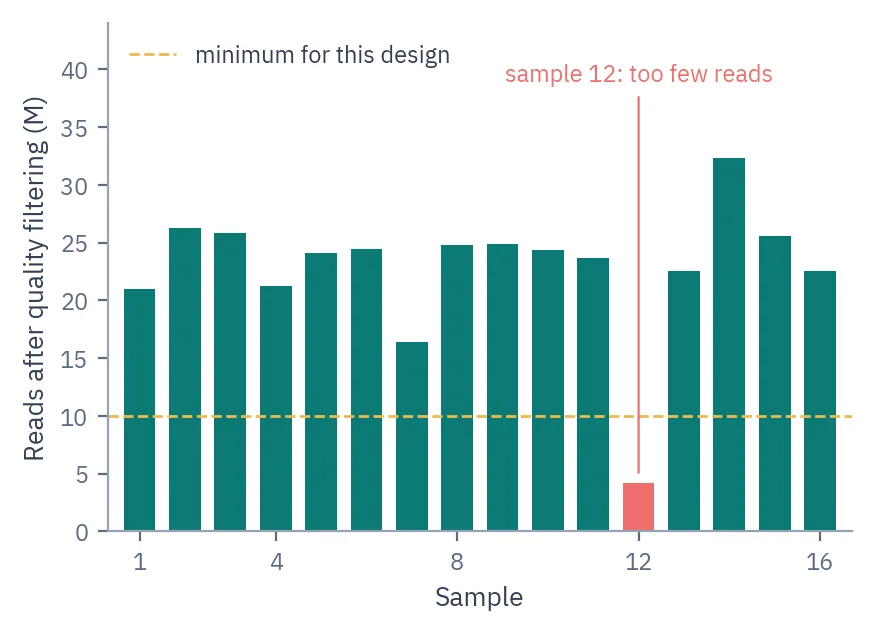
Enough reads in every sample?
Reads left after quality filtering, per sample. One sample falls below what the design needs and is flagged before the analysis starts.
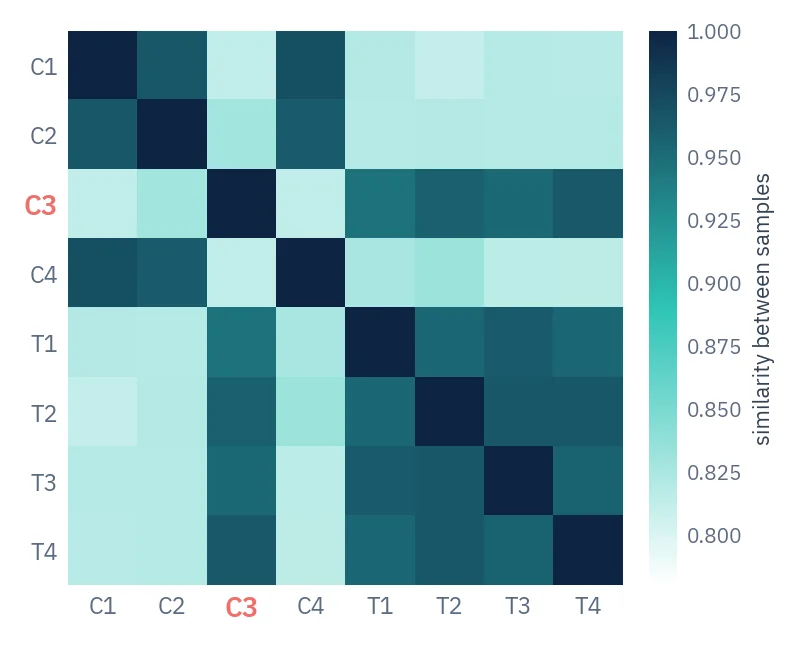
Do the labels match?
How similar the samples are to each other. Sample C3 resembles the treated group, a typical sign of a swapped label that is worth checking before any statistics.
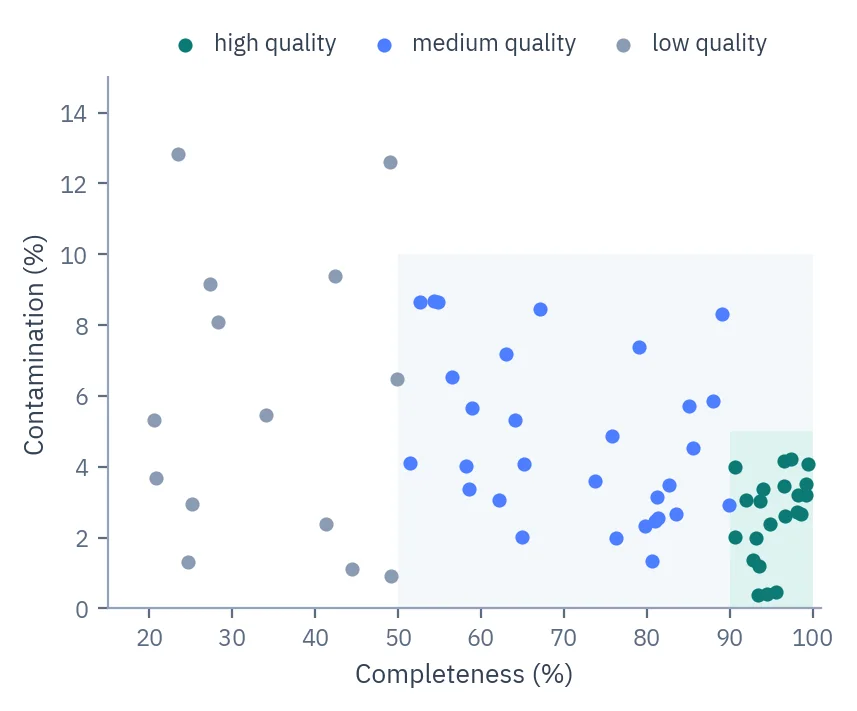
Genomes from a metagenome
Each dot is a draft genome rebuilt from shotgun data. The teal corner is over 90% complete and under 5% contaminated; the full high-quality label also needs the rRNA genes and tRNAs present.
Included as standard every project
- Data checkRead quality, adapter trimming and reads per sample, summarised for every sample.
- Analysis matched to the assayThe workflow for your data type: microbiome, RNA-seq, methylation, variants, assembly or population genomics.
- Statistics that fit the designGroup comparisons, replicates and multiple-testing correction set up for your study.
- Figures and tablesPublication-ready figures and all results as tables.
- Methods sectionMaterials & Methods text with the software versions used.
Added for your question custom
- Public datasetsRe-analysis of published data by accession number.
- Answers to reviewer commentsAdditional analyses when reviewers ask for them.
- Non-model organismsReference genome and annotation set up for species beyond the usual model organisms.
- Long-read dataOxford Nanopore and PacBio data as well as Illumina.
What goes in, and how we run it.
- Data we take
- Raw FASTQ files · public datasets by accession number
- Assays
- Amplicon, shotgun, RNA-seq, methylation, genomes and exomes, long-read assembly, ddRAD, T-cell receptor repertoires
- Platforms
- Illumina, Oxford Nanopore and PacBio data
- What we need
- Sample sheet with groups, organism and reference genome, library kit
- Delivered
- Report, figures, tables and Materials & Methods text
- Pipelines
- nf-core pipelines with fixed versions
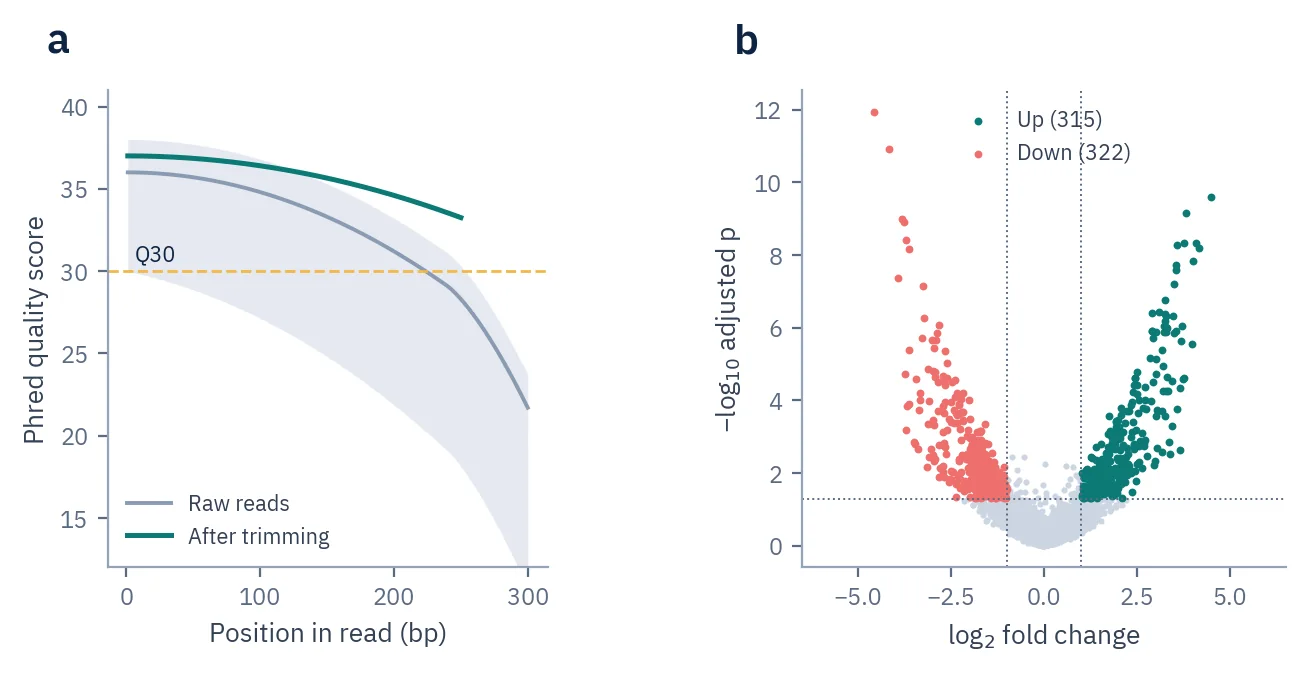
Figures, interpretation and Methods, ready for the manuscript.
- ReportInterpretation written against your hypothesis
- FiguresPublication-ready figures for the manuscript
- MethodsMaterials & Methods text for the paper
- Tables and dataAll results as tables, plus the processed data files
Analysis only or a full project?
Bring the question to the call and the scientist recommends one, with the reasoning for your samples.
| Aspect | Bioinformatics only | Full project |
|---|---|---|
| You send | Existing data files | Samples |
| We deliver | Analysis, figures, tables and Methods | Everything from sample check and sequencing to figures |
| Guarantee | Covers the analysis and re-analysis | Covers the whole project |
| Best when | The data exists but the answers do not | You are starting a new study |
Straight answers before you email.
Related services
What data can I send you?
Raw FASTQ files from Illumina, Oxford Nanopore or PacBio. Aligned files, count tables, variant files, etc. also work if that is all you have, though the earlier in the chain we can start, the more can be checked and fixed. A public accession number works instead of files. You get an upload link, so nothing has to go through email or a drive in the post. If you are not sure what you have, send us the file names and the first few lines and we will tell you.
My data came from another company or core facility. Is that a problem?
No, it is most of what we do. What matters is that it gets checked before anything is built on it, because the quality report a sequencing provider sends is about whether the sequencer ran well, not about whether your experiment works. Those are different questions, and the second one is the one you care about. Send the files and the design and the first thing you get back is a straight read on whether the data supports what you want to ask of it.
Which experiments can you analyse?
Amplicon microbiome data, shotgun metagenomes, bulk RNA sequencing, DNA methylation, germline genomes and exomes, long-read genome assembly, population genomics from reduced-representation data, T-cell receptor repertoires, etc. If your assay is not on that list, ask, because the answer is often yes. Tell the scientist what the data is, what the design was and what you want to get out of it, and you will know before you send anything whether it is work we should be doing.
My provider already sent an analysis and I do not trust it. Can you check it?
Yes, and it is a common reason people come to us. Standard output from a sequencing provider is run the same way for every customer, which is fine for the generic parts and less so for your specific comparison, your batches and your question. We go back to the raw files and run it against your design. Sometimes the conclusion holds and you get the confidence to publish it. Sometimes it does not, and you find out now rather than from a reviewer. Either way you get the reasoning, not just a different number.
What happens if you find something wrong with my data?
You hear about it immediately, with what it means and what the options are. A failed sample, a group with too few reads, a batch that lines up with your treatment, a label that does not match, etc. Some of these can be worked around, some narrow what you can claim, and some cannot be fixed by any analysis at all. You get told which kind it is while there is still a chance to do something about it, and we go through the options with you rather than picking one for you.
Can you re-analyse a published dataset?
Yes. Send the accession number and say what you want compared. The usual obstacle is not the data but the description attached to it: public archives vary a lot in how well samples are labelled, and group assignments, tissue, timepoints, etc. are often incomplete or inconsistent, so some of it has to be reconstructed from the paper. We check what is actually recoverable before building anything on it. Combining your own data with a public set is also possible, though the batch difference between them then needs handling.
My organism is not a model organism. Can you still analyse the data?
Usually yes, and what changes is what exists around the genome rather than the analysis itself. A reference, gene annotation and the databases used for pathway work all have to be there or be built. If the annotation is missing or thin, we can predict the genes from the genome ourselves and then predict what they do by matching the proteins against databases, so the project does not stop there. For some species a close relative can carry part of the work. Tell us the species and we check what is available and say which parts of the result will be strong and which will be approximate.
Which reference genome and annotation do you use, and does it matter?
It matters more than most people expect. Different human reference versions give different variant lists, and the newest complete reference recovers millions of variants that older ones miss entirely. Annotation sources also disagree about gene boundaries and about which genes exist, so the same reads give different counts depending on which file was used. None of that is an error, but it does mean results built on different references are not directly comparable. We use whichever version your project needs, usually the one matching your existing data or your collaborators, and the exact versions go into the Methods text.
Do I get the code, and can I run it again myself?
Yes. You get the analysis code, the configuration, the software versions and the parameters used. The main steps run in versioned community pipelines rather than in one-off scripts, so what you receive is something that can actually be run again, by you or by anyone else. This matters more than it sounds. Studies looking at published biomedical papers have found that around half share no analysis code at all, and that attempts to reproduce published analyses succeed only a small part of the time.
Will the analysis still be reproducible in two years, or for a reviewer?
That is what the pipeline choice is for. Each step runs inside a fixed software container at a pinned version, so the same input gives the same output later, on a different machine, after the tools have moved on. The versions go into the Methods text. Without that, re-running an analysis a year later quietly gives different numbers, because a tool updated underneath it. If a reviewer or a collaborator wants to repeat what was done, you have what they need to do it.
Will I get figures and a Methods section I can publish?
Yes. Figures at publication resolution with the underlying tables, and a Materials and Methods text naming every tool, version and parameter used, written to be adapted rather than rewritten. The figures are built to be read: axes labelled, statistics stated, and nothing in a colour scheme that falls apart in print. If your target journal has particular requirements for figure format or for how statistics are reported, tell us which journal and they are followed from the start.
What if a reviewer asks for a different analysis?
You send it to us and we run it. That is covered by the guarantee on analysis projects, and it is one of the main reasons the guarantee exists, because reviewer requests arrive months after the work is finished and cannot be planned for. There is no limit set in advance on how many rounds that is. Send the reviewer comments exactly as they are written and the scientist works out what is actually being asked for, which is often not quite what the sentence says.
How do you handle human data and data protection?
Human sequencing data counts as a special category of personal data under European rules, and pseudonymised data still counts, because a genome identifies the person it came from. So it is handled under a written processing agreement, transferred over encrypted links rather than email, kept only as long as the project needs it, and deleted on request. Do not send identifiers you do not have to send, because sample codes are enough for the analysis. If your institution has its own requirements, or an ethics approval with conditions attached, send them and we work inside them.
Can you help me get the data into a public archive?
Yes, and it is worth starting earlier than most people do, because journals increasingly want an accession number before a paper is accepted, and the archives need more about each sample than anyone remembers a year later. Which archive depends on the data: open archives for most organisms, and controlled-access ones for identifiable human data, where access runs through a committee you set up. We prepare the files and the metadata in the form the archive expects. Tell us where you plan to publish and we work backwards from that.
Start the project that ends in a paper.
One sentence will do. What the samples are and what you need to know. A scientist handles the rest.
- [email protected] Projects, samples and invoices
Start without committing to anything
- One sentence to start
- A short call to get the details
- A design, with the reasoning behind it
- Free shipping worldwide
- Free pre-analysis if you qualify
- Nothing starts until you agree