
DNA methylation sequencing: where the chemical switches on your DNA differ between groups.
Bisulfite sequencing measures methylation at single CpG sites across the genome or its CpG-rich regions, then finds the sites, regions and promoters that changed and the genes they sit in.
A chemical trick makes methylation readable.
DNA methylation is a small chemical tag on the letter C that helps switch genes on and off without changing the DNA sequence. In animals it sits mostly where a C is followed by a G, a CpG site. Plants also methylate Cs in other contexts.
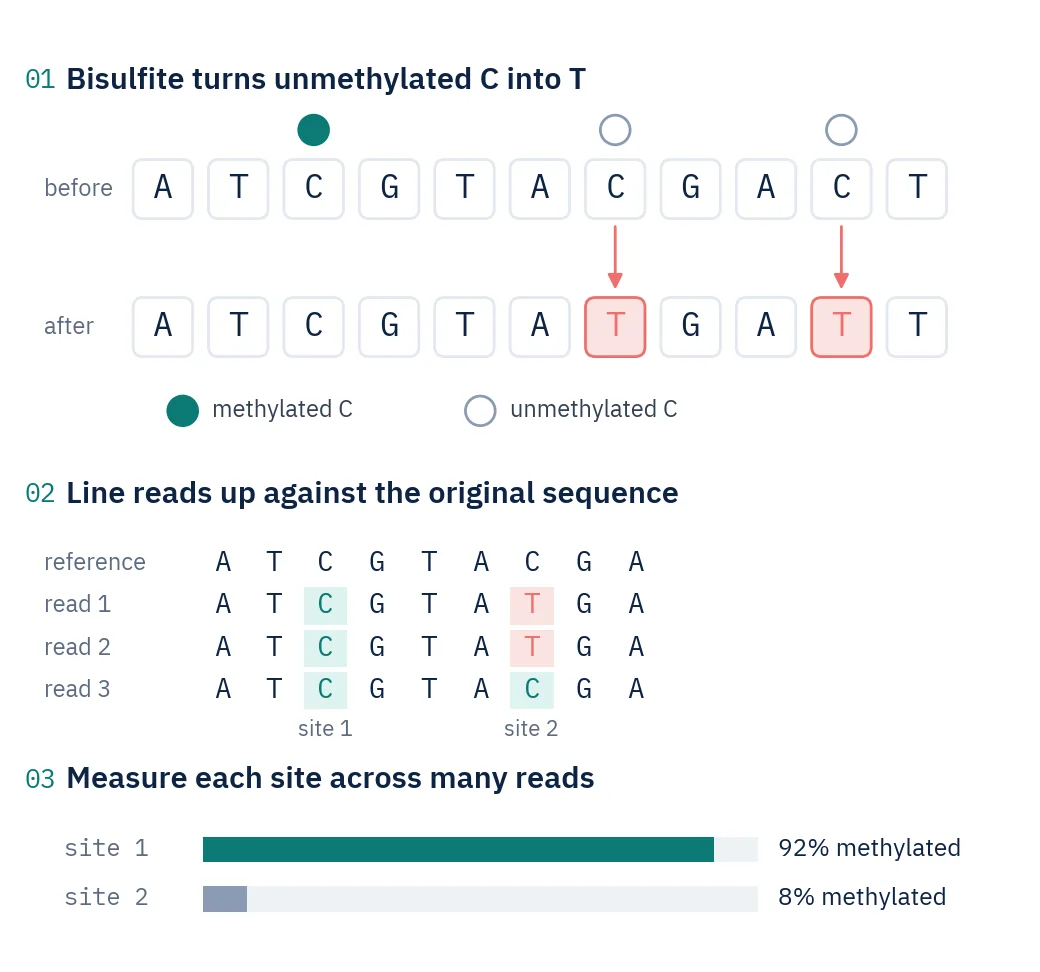
Sequencers cannot see the tag directly, so the DNA is treated with bisulfite first. Bisulfite turns every unmethylated C into T, while methylated C stays C. After sequencing, each C that is still a C marks a methylated site.
Counting reads at each site gives its methylation level: 9 reads with C out of 10 means 90% methylated. Comparing these levels between groups reveals single sites, regions and promoters that gained or lost methylation.
Whole-genome bisulfite sequencing (WGBS) reads the entire genome. Reduced-representation bisulfite sequencing (RRBS) cuts the DNA with an enzyme and reads only CpG-rich fragments, which covers most promoters for far less sequencing.
Key terms
- CpG site
- A place where the letter C is followed by G. The main target of methylation in mammals.
- Bisulfite conversion
- A chemical treatment that turns unmethylated C into T and leaves methylated C unchanged.
- Methylation level
- The share of reads at a site that show methylation, from 0% to 100%.
- DMR
- Differentially methylated region: a stretch of DNA whose methylation differs between groups.
- Hyper- and hypomethylation
- More or less methylation in one group than in the other.
- RRBS
- Bisulfite sequencing of the CpG-rich part of the genome, selected with a restriction enzyme.
Bring the question. We design the experiment around it.
- Where does methylation differ between my groups, at single sites and across regions?
- Which gene promoters gain or lose methylation?
- Is the change mostly a gain or a loss of methylation?
- Do my samples group by treatment on their methylation alone?
Where it is used
- Development and differentiationMethylation changes as cells specialise or organisms age.
- Disease mechanismsPromoter methylation changes linked to disease states.
- Environment and treatmentGroups exposed to different conditions, diets or treatments.
- Plant biology and cropsMutants, stress responses and traits, including plant-specific methylation contexts.
- Biomarker discoveryMethylation differences that separate groups.
- Lines and mutantsWild type compared with knockout or mutant lines.
Four steps from DNA to changed regions.
- Step 1
Choose WGBS or RRBS
We match the method to your question and sample numbers: whole genome for discovery, RRBS for more samples focused on promoters.
- Step 2
Check the DNA
DNA amount and integrity are checked before bisulfite treatment and library preparation.
- Step 3
Convert and sequence
Bisulfite treatment, library preparation and sequencing to the agreed depth.
- Step 4
Analyse and report
Methylation is called at every covered CpG, then sites, regions and promoters are compared, annotated to genes and tested for pathways.
What the analysis shows you.
Data quality at a glance
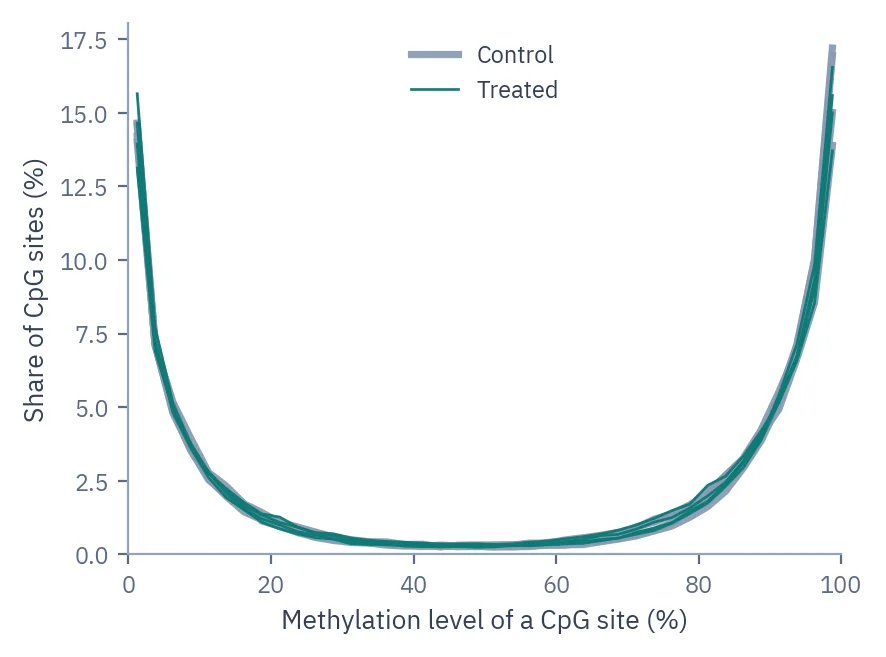
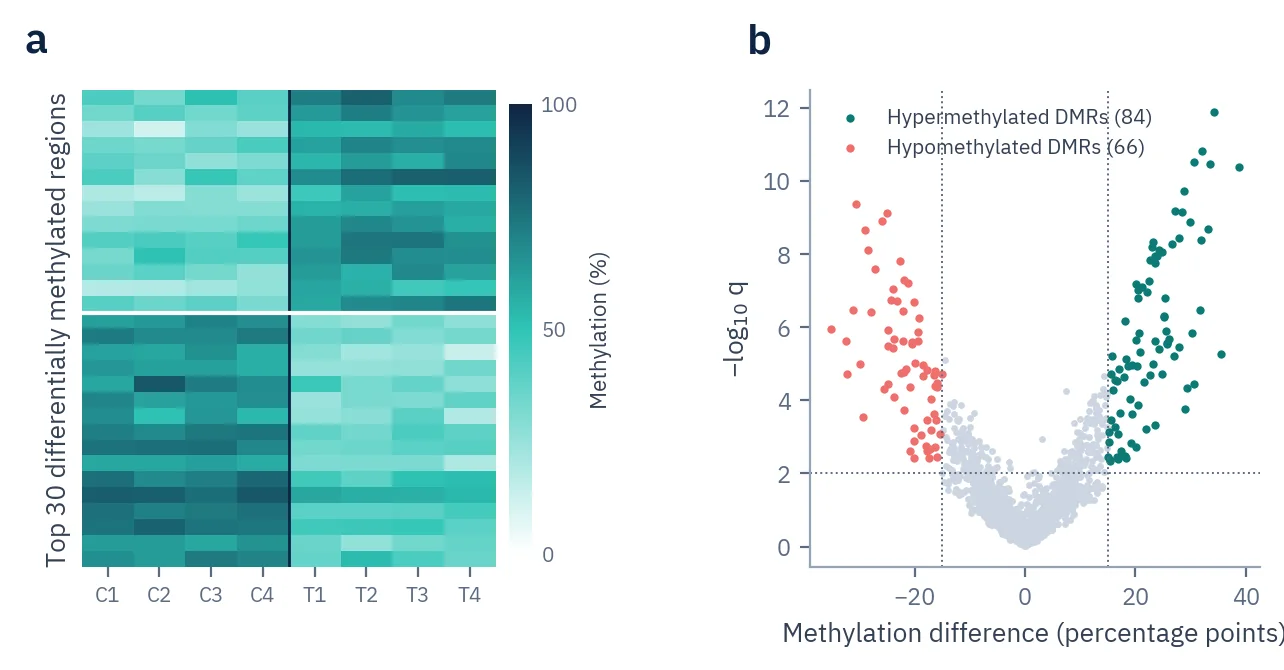
Most CpG sites are almost fully methylated or unmethylated, and every sample shows the same pattern, a sign of consistent data.
Where the changes fall
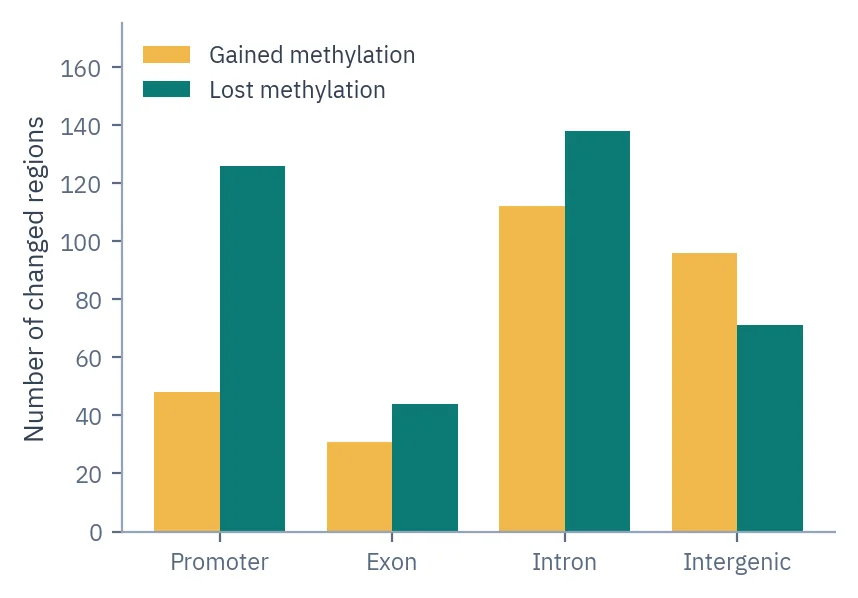
Regions that gained or lost methylation, sorted by where they sit relative to genes.
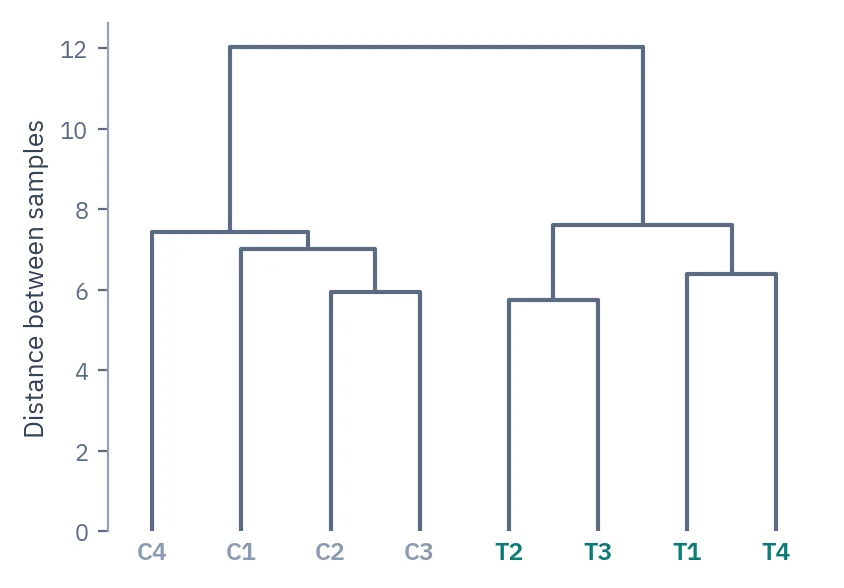
Do the samples group?
Samples clustered by their methylation profiles. Treated and control samples form two separate branches.
Included as standard every project
- Quality control and alignmentReads are trimmed and aligned with a bisulfite-aware aligner.
- Methylation callingThe methylation level of every CpG covered by at least 10 reads.
- Sample overviewCorrelation, PCA and clustering of samples.
- Differential methylationChanged sites, 1 kb regions and promoters, split into gains and losses.
- Annotation and pathwaysChanged regions linked to genes and promoters, with GO and KEGG enrichment.
Added for your question custom
- Plant methylation contextsCHG and CHH methylation in addition to CpG for plant genomes.
- RRBS for larger studiesThe CpG-rich part of the genome for more samples.
- Several comparisonsSeparate results for each pair of groups.
What goes in, and how we run it.
- Methods
- Whole-genome bisulfite sequencing (WGBS) · reduced-representation bisulfite sequencing (RRBS)
- Sequencing
- Illumina, 150 bp read pairs
- Typical depth
- About 30× genome coverage for WGBS
- Resolution
- Single CpG sites, 1 kb regions and promoters
- Samples
- Tissue, blood, cells and plants
- Main tools
- Bismark, nf-core/methylseq, methylKit, clusterProfiler
Figures, interpretation and Methods, ready for the manuscript.
- ReportInterpretation written against your hypothesis
- FiguresPublication-ready figures for the manuscript
- MethodsMaterials & Methods text for the paper
- Tables and dataAll results as tables, plus the processed data files
WGBS or RRBS?
Bring the question to the call and the scientist recommends one, with the reasoning for your samples.
| Aspect | WGBS | RRBS |
|---|---|---|
| Covers | CpG sites across the whole genome | CpG-rich regions such as promoters and CpG islands |
| Sequencing per sample | Much more | Much less, so more samples fit |
| Plants | All methylation contexts | Mainly CpG-rich regions |
| Best when | Discovery, and regions outside CpG islands | Larger studies focused on promoters |
Straight answers before you email.
Related services
Do you only do bisulfite sequencing?
No. We do bisulfite sequencing, enzymatic conversion, and methylation read directly from native DNA on PacBio and Oxford Nanopore. The long-read route needs no chemical conversion at all. The sequencer senses the tag on the molecule as it reads it, so the sequence and the methylation come out of the same run. Which one suits you depends on your organism, your sample type, what resolution you need and whether you also want the genome itself. Bring the question and the samples to the call and the scientist picks the route with you.
Bisulfite, enzymatic conversion or long reads for measuring methylation?
All three give methylation at single C positions. Bisulfite is the oldest and most published, so your results sit next to decades of other work. Enzymatic conversion does the same job with chemistry that is gentler on the DNA, which helps with small or damaged samples and gives more even coverage. Long reads skip conversion entirely and read the tag off native DNA, which also gives you phasing, repeats and the sequence itself. Tell the scientist the organism, the sample type and what you need to compare your results against, and the route is chosen from that.
What do long reads give me that bisulfite sequencing does not?
Four things. Methylation can be assigned to one parental copy or the other, so imprinting and allele-specific effects become visible. Regions where short bisulfite reads cannot be placed uniquely, such as repeats, become readable. 5mC and 5hmC can be told apart, and on nanopore so can methylated adenine. And the same run gives you the sequence as well: variants, structural changes and methylation from one library, rather than two separate experiments. If any of that matters to your question, say so on the call, because it decides the platform.
Is methylation from long reads as accurate as bisulfite?
At the level most projects work at, yes. Across a population of molecules the agreement with bisulfite is strong, and for averages over CpG islands and regions the two line up very closely. Single-molecule calls are a different matter: deciding the state of one CpG on one read is harder, and that is where accuracy drops. So depth still matters, for the same reason it matters in bisulfite work, because every site needs enough reads behind it. The scientist sets the depth from what you need to resolve.
WGBS or RRBS?
Whole-genome bisulfite sequencing reads CpG sites across the entire genome and suits discovery, including everything outside CpG islands. Reduced representation cuts the DNA with an enzyme first and reads only the CpG-rich fragments, which still covers most promoters and CpG islands but a small share of the genome overall. So it is a trade: the whole picture, or many more samples for the same amount of sequencing. If your question is about promoters and you need the sample numbers, reduced representation earns its place. We work that out with you on the call.
Could a methylation array do this instead?
Sometimes, and it depends on your species. Arrays measure a fixed set of positions chosen in advance. The human ones cover around a million CpGs, a few percent of the roughly 28 million in the human genome. There is also a mouse array, covering about 285,000 positions. Outside human and mouse, most species have no array at all. Arrays are reproducible and there is a large body of comparable data behind them. Sequencing measures whatever is there, including regions no array covers, and it works in any species. Tell the scientist which species you work on and what you want to compare against, and both routes get weighed.
How many replicates do I need?
More than most people plan for, and more replicates beat more sequencing per sample. Published work on this is clear: three biological replicates at modest coverage find differences that two replicates miss even at much higher coverage. Two per group is a published minimum for reference projects, not a target. Technical replicates do not help, because the variation that limits you is biological. Tell the scientist how many samples you can realistically collect and what size of difference matters to you, and the design is built around that rather than a round number.
How deep does the sequencing need to be?
It is set by how many reads each site needs, not by a headline number. Sites are usually only used once at least ten reads cover them, so the depth is planned to put most of your CpGs over that line. Past a point, extra depth stops buying much and the same effort spent on another replicate buys more. Long-read work follows the same logic with its own numbers. So the target depends on your genome, your method and the size of difference you want to see, and the scientist sets it with you.
Do I need a reference genome?
For the standard analysis yes, because reads are aligned to a reference and methylation is reported at positions on it. A close relative sometimes works, but with conversion-based methods the reads have lost most of their Cs, which makes alignment harder and makes mismatches against a distant reference more costly than usual. If your species has no reference, that is worth raising early, because building one first changes the order of the work. Tell us the species on the call and we check what is available before anything is planned.
Can you do this for organisms other than human and mouse?
Yes. Human, mouse, rat, plants, fungi, insects, fish, bacteria, etc. What changes is what is available around the genome: the reference itself, gene annotation, promoter definitions and the pathway databases used at the end. For well-studied species all of that is ready. For less-studied ones some of it has to be built or borrowed from a relative, and the pathway step may be thinner. Tell the scientist the species on the call and you get a straight account of what will be solid and what will be approximate.
How much DNA do you need, and what quality?
It depends on the route. Conversion-based methods can work from small amounts, and the enzymatic version tolerates less material and more damage than bisulfite. Long-read work is the demanding one: it needs more DNA and the molecules have to stay long, because the read length is the whole point. Bisulfite treatment itself destroys a large part of what you put in, which is why input and handling matter more here than in ordinary sequencing. We also do DNA isolation here. Bring the sample type to the call and we plan the extraction around the method.
Can you work with FFPE blocks?
Often yes, and it depends on how badly the DNA has degraded, which varies with how the block was fixed and how old it is. Enzymatic conversion handles fragmented material better than bisulfite, because bisulfite damages DNA that is already damaged. Long reads are the wrong tool here, since the molecules are short to begin with. The fragment size gets measured first and the method is chosen from what it shows. Tell us the age of the blocks and how they were fixed and the scientist says what is realistic before any of them are consumed.
Can you work with cell-free DNA from blood plasma?
Yes, and it is a demanding sample. Cell-free DNA comes in short fragments at low concentration, so the amount from a tube of plasma is small, and how the blood was collected and spun matters a great deal. Enzymatic conversion is the usual choice because it works from small amounts and does not destroy the little you have. The fragment pattern itself carries information alongside the methylation. Tell the scientist how the plasma was collected and stored, because that decides more about the result here than anything downstream.
Does it matter which tissue I use?
It matters more than almost anything else in the design. Methylation differs strongly between cell types, so a tissue made of several cell types gives you a blend. If your groups differ in their cell composition, which is common in blood and in diseased tissue, you can see a large methylation difference that is really a difference in which cells were present. There are ways to estimate and correct for this, and for some tissues sorting or isolating cells first is the better answer. Bring the tissue and how the samples were taken to the call, because this is where studies go wrong.
Can you detect methylation on adenine?
Yes, on both long-read platforms, read directly from native DNA. Nanopore calls it from the signal as the molecule passes through the pore, and PacBio from the timing of the polymerase as it copies the strand. This matters most for bacteria and archaea, where methylated adenine is common and sits on specific recognition motifs. In animals and plants, claims about adenine methylation have been hard to reproduce and the levels are very low, so results there need good controls. Conversion-based methods cannot see it at all, because the chemistry only acts on cytosine. Tell the scientist which organism and which modification you are after and the platform follows from that.
Can you tell which of the two parental copies a methylation mark sits on?
With long reads, yes. A single long molecule carries both the genetic variants and the methylation marks along its length, so the methylation can be assigned to one copy or the other. That is what makes imprinting, allele-specific methylation and the effect of a variant on nearby methylation visible. Short conversion-based reads are too short to do this reliably, because they often carry no variant to anchor them. If the two copies behaving differently is the point of your study, say so, because it decides the platform before anything else.
What counts as a real methylation difference?
Two things together, and neither alone is enough. The size of the difference, because a shift of a few percent at a site is rarely biologically meaningful even when the statistics call it significant. And the statistics, because with enough reads tiny differences become significant. So a threshold on the difference is set alongside the statistical test. What that threshold should be depends on your biology and on how variable your samples are, and the scientist sets it with you before the comparison is run.
Can I get the genome sequence and the methylation from one run?
Yes, by more than one route. On the long-read platforms the same reads give you the sequence, the variants, structural changes and the methylation, because the modification is sensed on the molecule as it is read. There are also short-read kits that convert methylated cytosine instead of unmethylated cytosine, which leaves most of the sequence intact and allows variants and methylation from one library. Bisulfite and the usual enzymatic conversion work the other way and make variant calling much harder, especially at C and T positions. Long reads still have the advantage for phasing, repeats and structural changes. Say early that you want both, because it decides the platform and the DNA you need.
Can you combine the methylation results with my RNA sequencing?
Yes, and it is usually worth it. Methylation on its own tells you a mark changed. Putting it next to expression tells you whether anything downstream responded, which is the part reviewers ask about. The two are linked gene by gene, so changed regions can be checked against the expression of the genes they sit in or near. It works best when the RNA and the DNA come from the same samples. If you plan to do both, say so before the samples are collected, because that is when it is easy to arrange.
What do I get back from a methylation project?
Methylation levels at every covered position, the changed sites, regions and promoters with their differences and statistics, the annotation to genes, the pathway results, the sample overview with clustering, the quality numbers including the conversion rate, etc. Plus any custom analysis your research question needs. Figures at publication quality and a Methods section written for a journal. Then a report that explains what the numbers mean for your biology, not only what they are. If something in the data limits what you can conclude, the report says so and says why.
I already have methylation data. Can you analyse it?
Yes. Send the raw files and tell us how they were made: bisulfite or enzymatic conversion, whole genome or reduced representation, which platform, read length, whether a conversion control was included, and which reference you want. If it is long-read data, say which platform and which basecaller version produced the methylation calls, because that affects what the numbers mean. We run the quality checks first and tell you what the data supports before building any comparisons on top of it.
Start the project that ends in a paper.
One sentence will do. What the samples are and what you need to know. A scientist handles the rest.
- [email protected] Projects, samples and invoices
Start without committing to anything
- One sentence to start
- A short call to get the details
- A design, with the reasoning behind it
- Free shipping worldwide
- Free pre-analysis if you qualify
- Nothing starts until you agree