
De novo genome assembly: a genome sequence for an organism that has none.
We sequence long DNA molecules on PacBio or Oxford Nanopore, join them into a genome, check how complete and clean it is, and confirm which species it is.
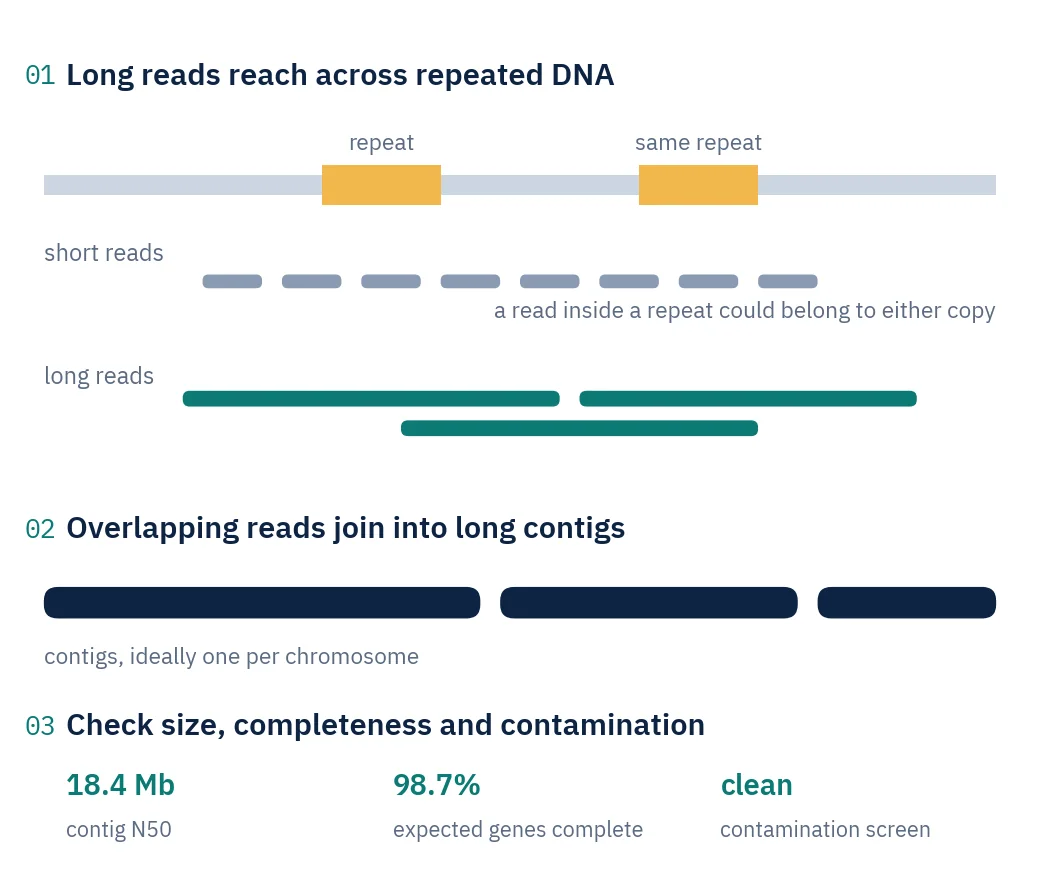
Long reads keep a genome in one piece.
De novo means from scratch: there is no reference genome to compare against, so the genome is rebuilt from the reads alone. Overlapping reads are joined into continuous stretches called contigs. The fewer and longer the contigs, the better the assembly.
Every genome contains repeats, stretches of DNA that occur in several places. A short read that falls inside a repeat could belong to any copy, so short-read assemblies break at repeats. A long read runs across the repeat into the unique DNA on both sides and shows how the pieces connect.
PacBio HiFi reads are long and highly accurate; Oxford Nanopore reads can be even longer. Short Illumina reads can be added to polish remaining errors. Before sequencing, the expected genome size is checked in public databases so the amount of sequencing fits the genome.
Key terms
- Contig
- A continuous stretch of assembled sequence without gaps.
- N50
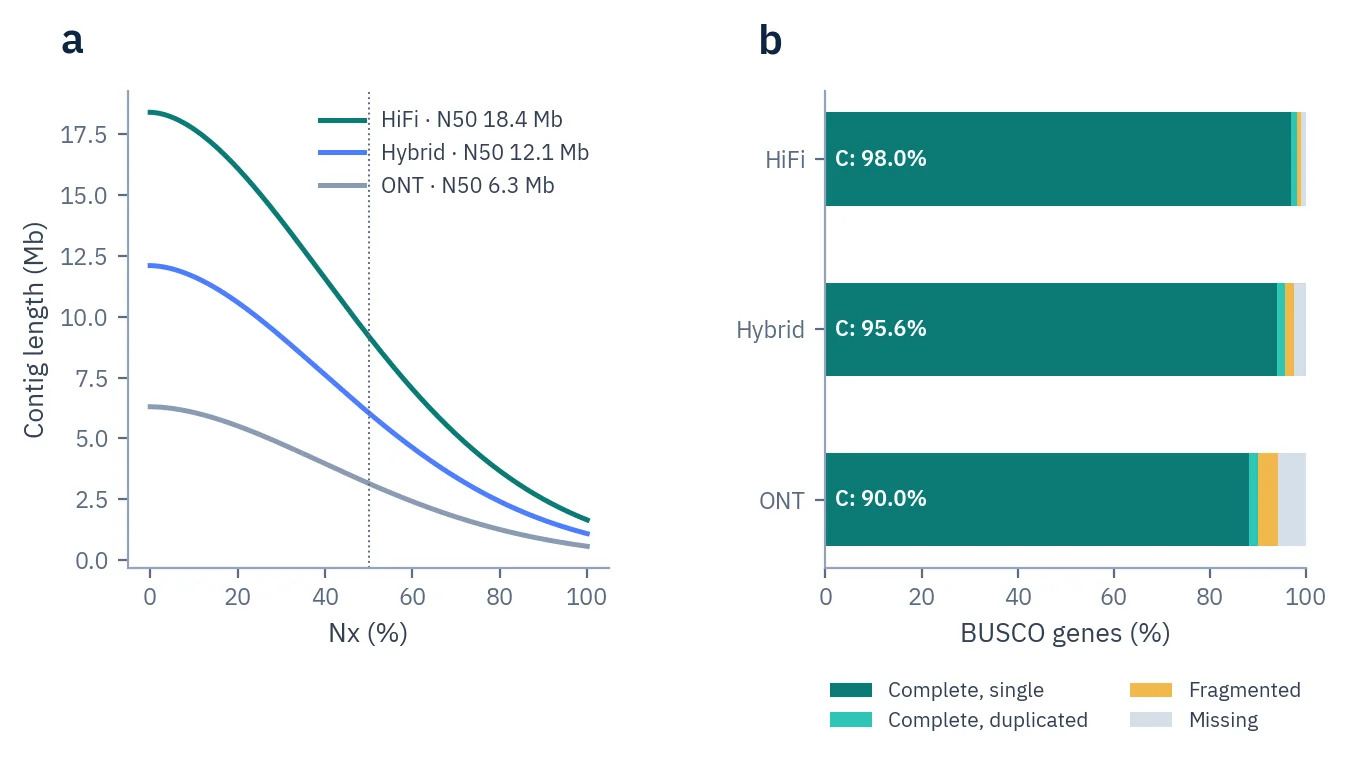
- Half of the assembly sits in contigs this long or longer. Higher is better.
- BUSCO
- A completeness check that looks for genes almost every species in a lineage carries.
- HiFi read
- A PacBio long read made by reading one DNA molecule many times, more than 99.9% accurate.
- HMW DNA
- High-molecular-weight DNA: long, intact molecules, needed for long reads.
- ANI
- Average nucleotide identity between two genomes. Microbes that share 95% or more are usually the same species.
Bring the question. We design the experiment around it.
- Nobody has sequenced this species. Can I get a genome to map my other data against?
- How big and how heterozygous is this genome?
- Is my bacterial chromosome closed, and which plasmids does the strain carry?
- Is my isolate really the species I think it is, and is the culture pure?
Where it is used
- Reference genomes for new speciesA first genome for organisms without one, or a better one than a fragmented draft.
- Complete bacterial and yeast genomesClosed chromosomes and plasmids from long reads.
- Isolate identity and puritySpecies confirmation and detection of mixed or contaminated cultures.
- Protists and other eukaryotesGenomes with gene models for less-studied single-celled organisms.
- Methylation from the same run5mC and 6mA marks read directly from native DNA.
- A base for later studiesThe assembly becomes the reference for resequencing, RNA-seq and population work.
Four steps from DNA to a checked genome.
- Step 1
Size the project
We check the expected genome size in public databases and plan the DNA extraction and sequencing depth with you.
- Step 2
Check the DNA
Long reads need long, intact DNA, so amount and fragment length are checked before library preparation.
- Step 3
Sequence long reads
PacBio HiFi or Oxford Nanopore, with Illumina reads added when polishing helps.
- Step 4
Assemble and check
Reads are assembled, then checked for contiguity, gene completeness and contamination, and delivered with a report and Methods.
What the analysis shows you.
Sizing the genome
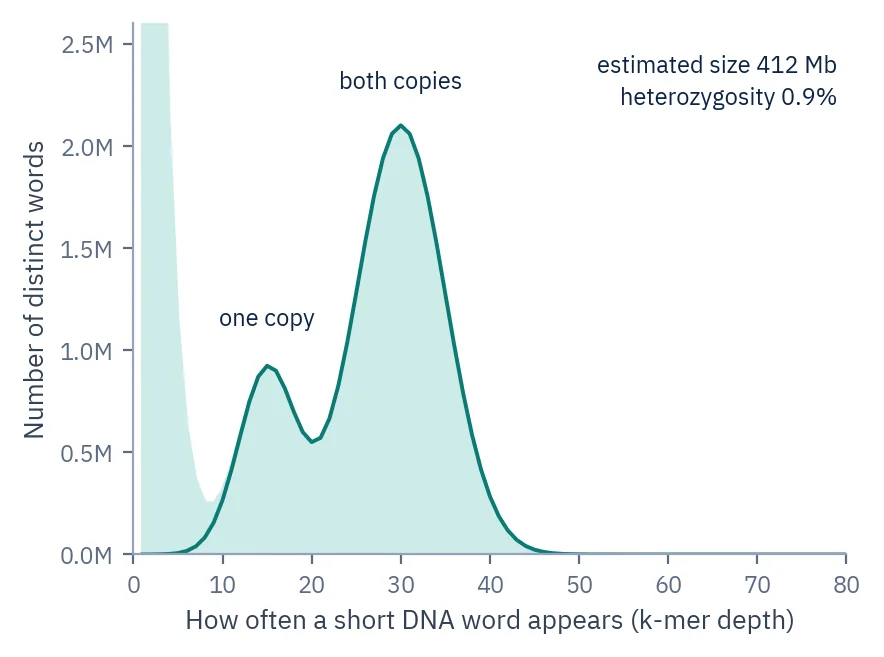
Counting short DNA words in the reads reveals the genome size and how different the two parental copies are, before the assembly starts.
Is it the species you think?
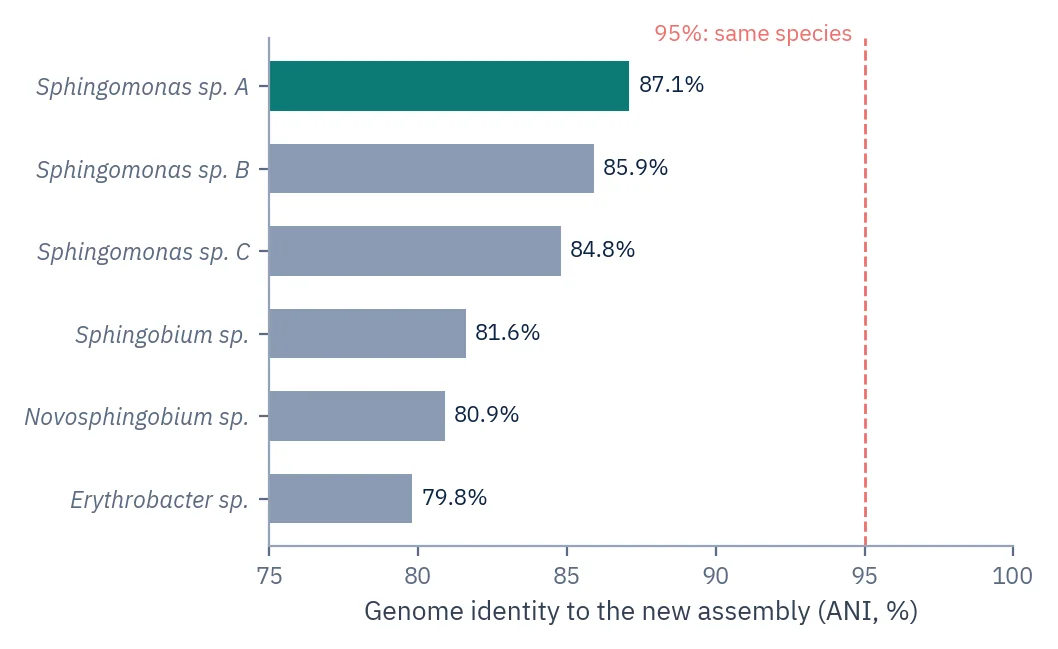
Genomes of one species share at least 95% identity. This isolate’s closest match falls below that line, which points to a species not yet described.
Every contig accounted for
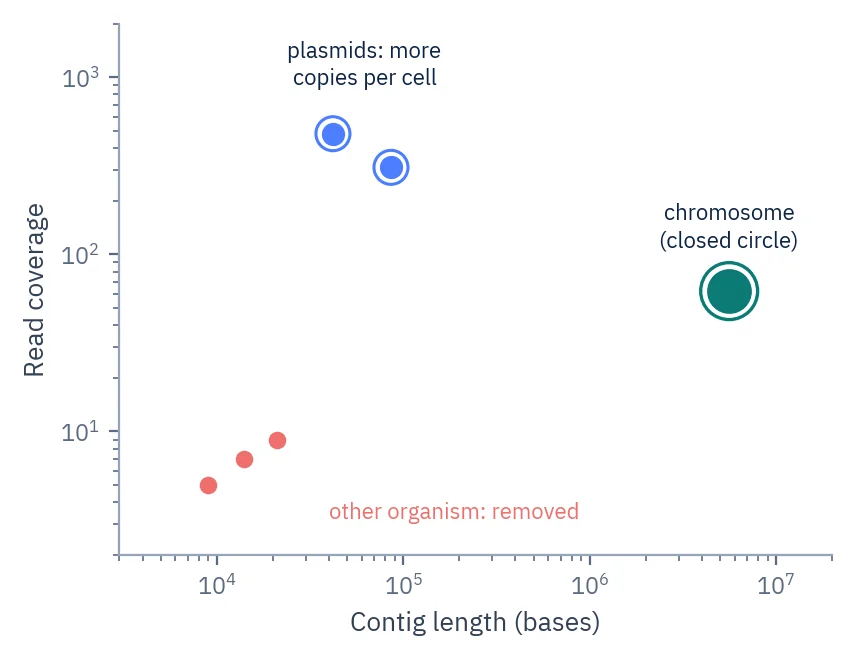
The chromosome and plasmids close into circles. Plasmids have higher coverage because cells carry several copies, and stray contigs from another organism are removed.
Included as standard every project
- AssemblyLong reads joined into contigs, with an assembly graph that shows how they connect.
- Contiguity statisticsNumber of contigs, total length and N50.
- Gene completenessBUSCO check against the lineage your organism belongs to.
- Report and MethodsA readable report, a Materials & Methods document and checksums for every file.
Added for your question custom
- Genome surveyGenome size and heterozygosity estimated from the reads.
- Species identity and contamination16S and whole-genome identity to reference genomes, and a check of every contig.
- Closed circles for microbesCircular chromosomes and plasmids marked, with read coverage per contig.
- Polishing with short readsIllumina reads correct remaining errors in a long-read draft.
- Gene modelsGene structures predicted for eukaryotic genomes.
- Methylation5mC and 6mA calls from PacBio HiFi data, delivered as genome tracks.
What goes in, and how we run it.
- Sequencing
- PacBio Revio HiFi · Oxford Nanopore PromethION · Illumina for polishing
- Typical depth
- About 60× HiFi coverage of the expected genome size
- Before sequencing
- Genome size checked against public databases
- Input
- High-molecular-weight DNA in microgram amounts · extraction planned with you
- Organisms
- Bacteria, yeasts and fungi, protists · plants and animals
- Main tools
- hifiasm, Flye, SPAdes, QUAST, BUSCO, GenomeScope2
Figures, interpretation and Methods, ready for the manuscript.
- ReportInterpretation written against your hypothesis
- FiguresPublication-ready figures for the manuscript
- MethodsMaterials & Methods text for the paper
- Tables and dataAll results as tables, plus the processed data files
PacBio HiFi or Oxford Nanopore?
Bring the question to the call and the scientist recommends one, with the reasoning for your samples.
| Aspect | PacBio HiFi | Oxford Nanopore |
|---|---|---|
| Read accuracy | Above 99.9% per read | Lower per read, corrected by depth and polishing |
| Read length | Long, typically 15–25 kb | The longest reads of any platform |
| DNA needed | High-molecular-weight DNA | High-molecular-weight DNA, more for the longest reads |
| Methylation | Read from native DNA | Read from native DNA |
| Best when | Accurate, contiguous assemblies of most genomes | Very long repeats, or combined with short reads in a hybrid assembly |
Straight answers before you email.
Related services
Which organisms can you build a genome for?
Bacteria, archaea, yeasts and fungi, protists, insects, fish, plants, animals, etc. Ask about yours. What changes between them is not the sequencing but how hard the genome is to put back together. A bacterial genome is small and usually closes into complete circles. A plant genome can be billions of letters, full of repeats, and carry four or six copies of each chromosome. On the call we look at the expected size, the ploidy and the repeat content for your species, and say what a realistic result looks like before anything is sequenced.
My species already has a published genome but it is fragmented. Is a new one worth it?
Often yes, and the honest test is whether the fragmentation is blocking your work. Old short-read drafts tend to break at repeats, miss genes in repeat-rich families, and carry sequence from the wrong organism. If your genes of interest sit in those regions, or you need gene order, regulatory regions or structural variants, a long-read assembly changes what you can do. If you only need variant calling in well-behaved coding regions, the existing one may be enough. Send us the accession before the call and we go through its real statistics with you.
PacBio HiFi or Oxford Nanopore for my genome?
HiFi reads are long and very accurate per read, so they suit most assemblies and need the least correction afterwards. Nanopore gives the longest reads of any platform, which helps across very long repeats, and current chemistry is accurate enough that bacterial genomes can be finished from nanopore alone. Many projects use both. The right choice depends on your genome size, repeat content and how long your DNA will survive extraction, so it gets settled on the call once we know the organism and the material.
Can I assemble a genome from Illumina short reads only?
You can get a draft, and for some questions a draft is enough: gene content, a rough catalogue, a first look at a small genome, etc. What you will not get is contiguity. Short reads cannot be placed inside repeats, so the assembly breaks wherever a repeat sits, and in a repeat-rich genome that is thousands of places. Gene order, repeat families and structural variants are what you lose. Tell the scientist what the genome is for and you get a straight answer on whether short reads will carry it.
Do I still need short reads if I am using long reads?
Depends on the platform and the genome. Accurate long reads often need no short-read polishing at all. A nanopore assembly may still benefit from short reads to clean up remaining base errors, though newer chemistry and basecallers have narrowed that gap a lot, especially for bacteria. Short reads are useful for other reasons too: estimating genome size and heterozygosity before assembly, and checking base accuracy afterwards. We say on the call whether your project needs them, and why.
How much DNA do I need for a long-read assembly, and what quality?
Library preparation generally needs microgram amounts with most molecules still tens of kilobases long. The amount on its own is not the useful part, because badly sheared DNA fails where a smaller amount of intact DNA works. So it has to be handled gently: wide-bore tips, no vortexing, no repeated freezing and thawing, and measured with a fluorometer rather than by absorbance. We also do high molecular weight DNA isolation here, so you do not have to solve this alone. Bring the species and the tissue to the call, because getting that DNA right is one of the most important parts of the whole project.
My organism is hard to extract clean DNA from. What then?
Common, and worth raising early. Plants carry polyphenols and polysaccharides that come through the extraction and interfere with the chemistry. Fungi and some bacteria have tough walls that need harder lysis, which shears the DNA you are trying to keep long. Insects and small animals bring their gut contents with them. Published methods exist for most of these, and they differ by family, not just by kingdom. Tell us the organism and the tissue and we plan the extraction with you, or do it here.
I only have a very small amount of material. Can you still assemble a genome?
Sometimes, and it depends on how small and on the platform. Low-input methods exist and have been used on single insects and small tissue pieces, but they are less forgiving. Less DNA means fewer unique molecules, and that shows up as shorter reads, more duplicates and a less contiguous assembly. Pooling several individuals solves the amount problem and creates a new one, because you are then assembling a mixture of genomes rather than one. Tell the scientist how much material you have and what the genome has to show, and both routes get weighed properly.
How much sequencing does my genome need?
It scales with genome size, because what matters is coverage, not the number of reads. Repeat content and heterozygosity push it up, because the assembler needs enough reads to tell near-identical copies apart. Nanopore assemblies usually need more coverage than accurate long reads to reach the same quality. So the depth comes out of your species and your question. Tell the scientist the organism and what the genome has to show, and the target is set from there.
My genome is large and full of repeats. Is that a problem?
It is the main thing that makes assembly hard, and it is also the thing long reads were made for. A repeat only breaks an assembly when no read is long enough to cross it and reach unique sequence on both sides. So the question is not how much repeat your genome has but how long the repeats are, and that is what decides the read length you need. Large genomes also need proportionally more sequencing. Tell the scientist the species and the expected size, and the read length target is set from what is known about its repeats.
Will I get chromosomes, or just a pile of contigs?
Often chromosomes. With nanopore and reads that are long enough, chromosome-level assembly is reachable, and for some genomes the long reads alone carry you most of the way. Hi-C, an optical map, a genetic map, etc. can be laid on top where more is needed. The real limit here is almost never the sequencer. It is whether DNA can be got out of your sample with the molecules still long enough, and most of the time that is the genuinely hard part of the project. So bring the species and the tissue to the call and we work out what is realistic before anything is sequenced.
How do you know the assembly is any good?
Three questions, measured separately, because one good number can hide a bad assembly. How contiguous it is: how many pieces, how long, and the N50. How complete it is: whether the genes expected for your lineage are present, and whether the DNA words in your reads are present in the assembly, which catches things a gene-based check misses. And how accurate each base is, scored by comparing the assembly back against the reads. All three go in the report with the numbers. There are also published community standards for what a reference-quality genome should reach, so your result can be placed against them.
What is N50, and should I care?
N50 means half of your assembly sits in pieces this long or longer. It is a size measure, not a quality measure, and it can be improved by joining things that do not belong together. So read it alongside the number of pieces, the total size against what you expected, and the completeness checks. Where people get caught is comparing an N50 from one paper against an N50 from another when one counts contigs and the other counts scaffolds, which include gaps. Our report states which one it is.
How complete will my genome be?
Measured two ways, because they fail differently. The gene check looks for genes almost every species in your lineage carries and reports how many are found, but it only covers conserved single-copy genes, so it says little about the hardest parts of the genome, and it can mislead for species far from anything well studied. The second check compares the DNA words in your raw reads against those in the assembly, which covers everything, including repeats. Together they tell you what is actually missing. Both go in the report, with the lineage used stated.
Can you get a telomere-to-telomere genome?
For some organisms yes, for others it is still research. Bacterial and yeast genomes routinely come out complete. For large eukaryotic genomes, gapless assemblies are now achievable but need long reads at depth, usually ultra-long reads as well, Hi-C, and real manual work on the hardest regions. Centromeres and ribosomal DNA arrays are where it gets difficult. Tell the scientist what the gaps would actually cost you scientifically, because for many questions a highly contiguous assembly answers everything a gapless one would.
How do you know the assembly is not contaminated with another organism?
Because it gets checked, and it is more common than people expect. Cultures pick up other organisms, kits and reagents carry their own DNA, and sequencing adaptors end up inside contigs. Every piece is screened against a broad reference set for sequence from other species, and separately for adaptor and vector sequence. Coverage helps too, since contigs from a contaminant usually sit at a different depth from the main genome. Anything flagged is shown to you with the evidence before it is removed, so you decide what goes.
Is my isolate really the species I think it is?
Worth checking, and the assembly answers it directly. We compare your genome against published reference genomes across the whole sequence, not just one marker gene, because two organisms can share a near-identical 16S and still be different species. For bacteria the usual line is average nucleotide identity: above about 95 percent to a reference is normally the same species, below it is not. Past projects here have turned up a likely new species and a culture holding three organisms rather than one. Both came out of the routine checks, not a separate experiment.
Will my bacterial genome come out as one closed circle, with the plasmids?
Usually, with long reads and enough depth. Each piece is reported as circular or linear, so you see at once which chromosomes and plasmids closed. Two honest caveats. Small plasmids, especially under a few kilobases, are recovered less reliably from long reads alone, because the size selection in library preparation works against them. And not every bacterial chromosome or plasmid is circular in the first place, so a linear result is not automatically a failure. If plasmids are the point of your study, say so, because it changes how the library is made.
Can you assemble genomes straight out of a mixed sample?
Yes, that is metagenome assembly, and long reads have changed what is possible. You get many drafts, one per organism, built from the mixture and then sorted into bins. How complete each one is depends on how abundant that organism was, so the dominant members can come out close to complete while rare ones stay fragmentary. Related strains in the same sample are the hard case, because the assembler cannot always tell them apart. Tell the scientist what you expect in the sample and how deep into it you need to go.
Will I get genes annotated on my new genome?
Yes if you need them, and it is a separate step from building the sequence. Repeats are identified and masked first, then gene structures are predicted using protein evidence from related species, with RNA sequencing from your own organism added where you have it. RNA data makes a real difference to the result, so if you can collect it, collect it from several tissues or conditions. Functional labels come from matching the predicted proteins against databases. On the call we say what level your question actually needs, since a gene catalogue and a publication-grade annotation are different amounts of work.
Can you assemble the mitochondrial or chloroplast genome too?
Yes, and usually from the same data, because organelles sit at far higher copy number than the nuclear genome, so the reads are already there. They are assembled separately, since the copy number and the circular structure confuse an assembler treating everything as one genome. Plant chloroplast genomes have a large inverted repeat that needs handling on its own. Say on the call if the organelle genome matters to you and it goes into the design rather than getting added later.
Can you read methylation from the same sequencing?
Yes. Both long-read platforms detect base modifications directly from native DNA, with no bisulfite step and no separate library, so methylation comes out of the run you were doing anyway. For bacteria this also identifies the restriction and modification systems the strain carries. You get the calls as genome tracks alongside the assembly. Tell the scientist you want it before the libraries are made, because the DNA must not be amplified, and amplification erases the marks.
What do I get back from a genome assembly project?
The assembly in FASTA, the assembly graph, the contiguity and completeness numbers, the base accuracy score, the contamination screening results, etc. For microbes, every piece labelled circular or linear with its coverage. Gene models and functional labels where the project includes them. Then a report explaining what the numbers mean for your organism, a Methods section written for a journal, and checksums for every file. If something came out worse than expected, the report says which part and why, so you know what the genome can and cannot be used for.
Can I submit this genome to NCBI or ENA?
Yes, and it is worth saying at the start because it shapes the work. Submission requires the assembly to pass contamination and adaptor screening, which we run as a matter of course, and it needs the sample and sequencing details recorded properly from the beginning. Those are far easier to collect as you go than to reconstruct a year later. Tell the scientist you plan to submit and the files and metadata come out in a form the archives accept.
I already have long-read data. Can you just assemble it?
Yes. Send the raw reads, say which platform and chemistry produced them and whether anything has been done to them already, plus whatever you know about the organism: expected genome size, ploidy, a related reference, etc. We run the assembly, the quality checks and the contamination screening, and tell you what the data can honestly support. If the reads cannot reach what you need, you hear that early and with the reason.
Start the project that ends in a paper.
One sentence will do. What the samples are and what you need to know. A scientist handles the rest.
- [email protected] Projects, samples and invoices
Start without committing to anything
- One sentence to start
- A short call to get the details
- A design, with the reasoning behind it
- Free shipping worldwide
- Free pre-analysis if you qualify
- Nothing starts until you agree